
Navigating California’s Home Insurance Crisis
The California homeowners insurance marketplace is experiencing an unprecedented structural contraction. As major private insurance carriers restrict new business or execute large-scale non-renewals across the state, property owners face a highly competitive landscape just to secure basic hazard coverage. Concurrently, state regulatory bodies have accelerated the enforcement of strict defensible space mandates as a primary mechanism to reduce risk portfolios.
A central catalyst in this shifting regulatory landscape is Assembly Bill 3074, a piece of legislation that updates traditional wildfire protection standards. Under this law, properties are subjected to precise physical inspections. Passing these inspections has evolved from a standard safety recommendation into a strict prerequisite for maintaining, renewing, or qualifying for conventional property insurance policies.
Furthermore, underwriting departments have heavily integrated advanced aerial drone photography, satellite imagery, and localized risk-modeling software into their daily review processes. An accumulation of backyard storage, dead vegetation, or unmanaged building perimeters can trigger an immediate non-renewal notice, leaving property owners scrambling to find coverage. Navigating this climate requires a meticulous approach to compliance, beginning with the structure's immediate perimeter.
The Science and Law Behind the 5-Foot "Ember-Resistant" Mandate
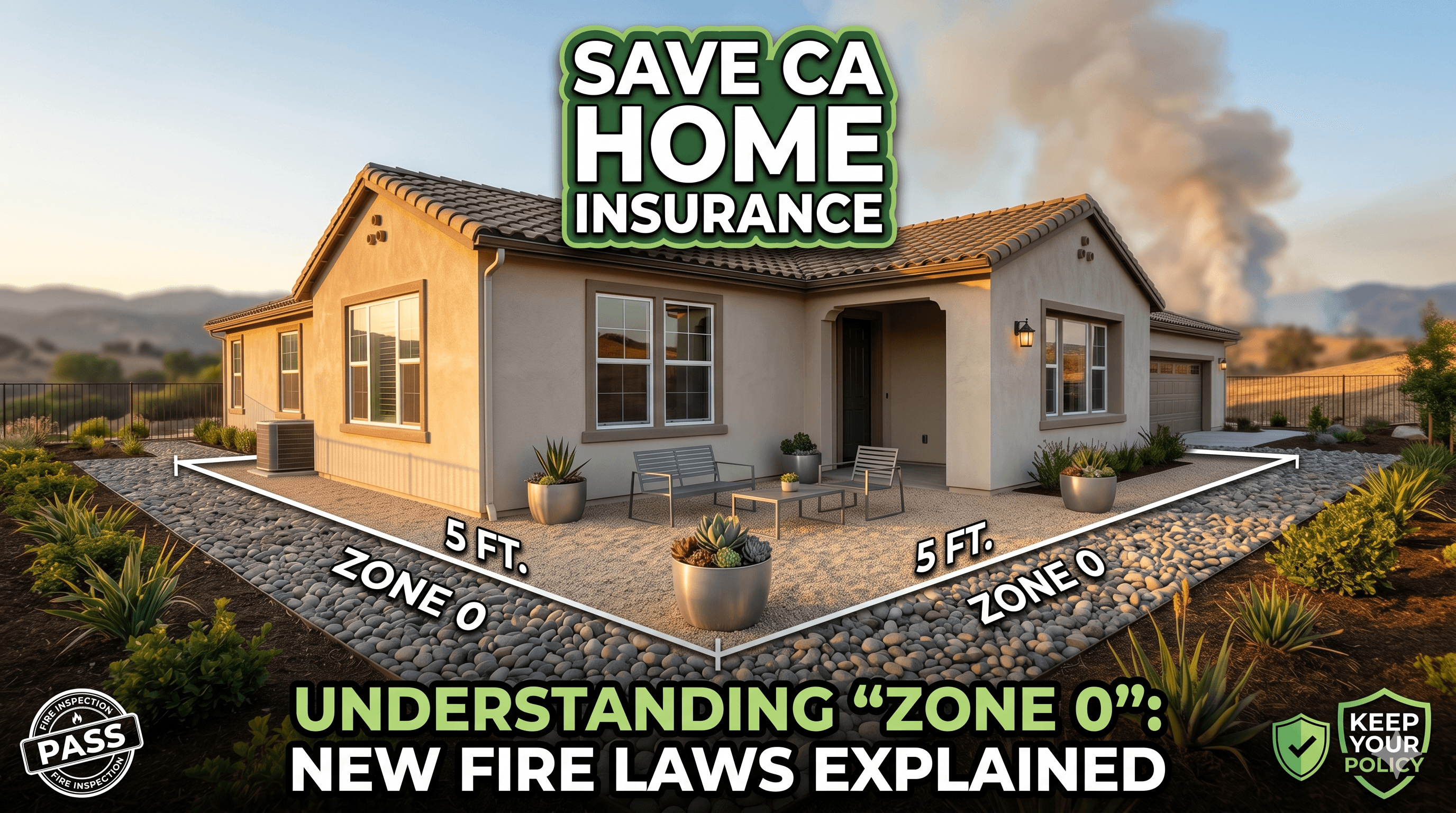
To understand the depth of Assembly Bill 3074, property owners must understand the concept of **Zone 0**. Historically, California fire safety focused heavily on Zone 1 (5 to 30 feet from a structure) and Zone 2 (30 to 100 feet). However, forensic wildfire analysis revealed a critical flaw: the vast majority of structural losses occur due to wind-borne embers traveling miles ahead of a fire front, landing in localized fuel beds directly adjacent to exterior walls.
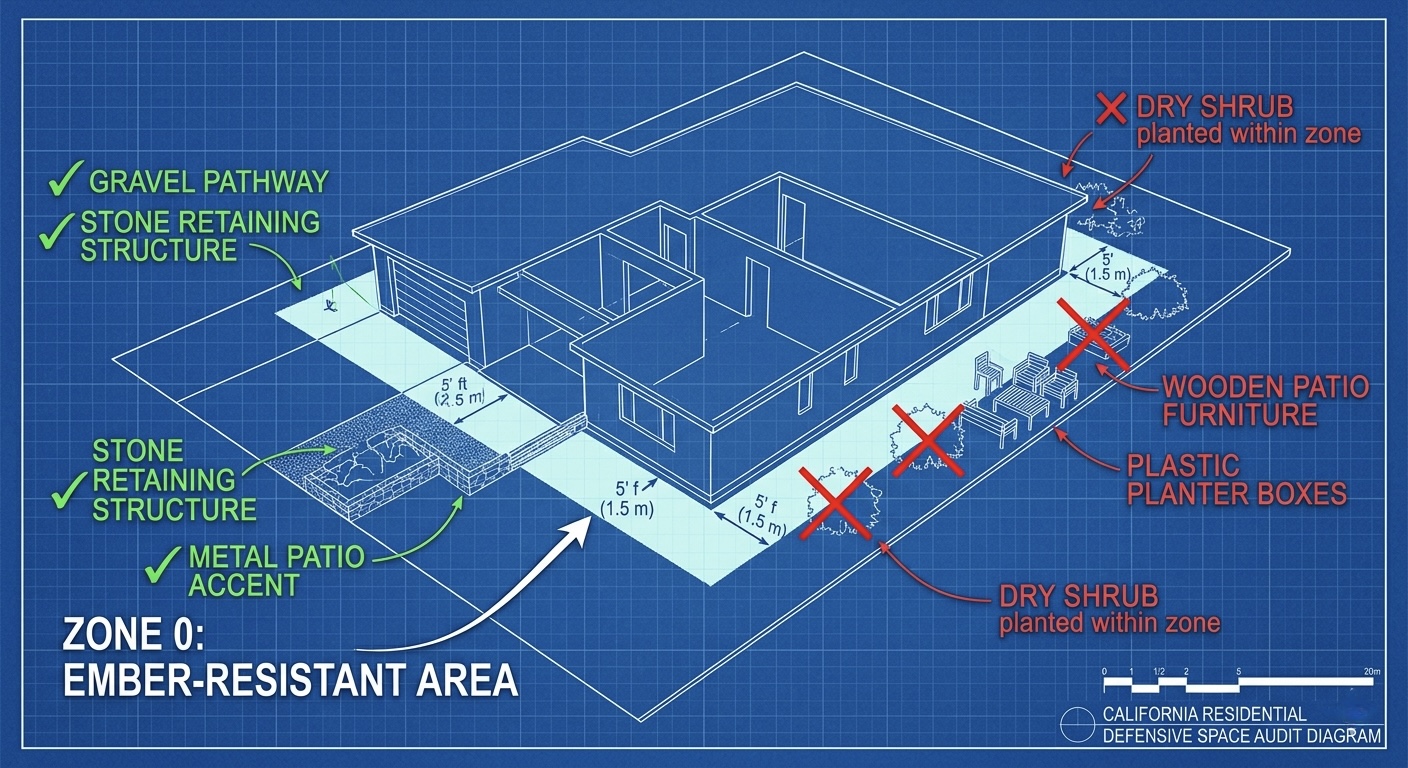
Zone 0 establishes a strict, **0-to-5-foot ember-resistant buffer** measured from the outermost point of any structure, including attached architectural features such as bay windows, decks, porches, and balconies. The objective is straightforward: eliminate any material capable of catching a floating spark and fueling a concentrated, high-heat fire against the foundation or siding of the building.
Why Small Fuel Beds Create Massive Risk
During a high-wind wildfire event, microscopic embers aggregate in the exact corners where walls meet the ground—the same areas where homeowners naturally store plastic bins, pile firewood, or layout organic landscape mulch. If these materials ignite, the resulting direct flame contact quickly breaches windows, crawls up siding, enters foundation vents, and compromises the roof structure in a matter of minutes. This is why inspectors are taking an absolute zero-tolerance approach to the first five feet.
Zone 0 Compliance Matrix: Violations vs. Approved Standards
Achieving compliance requires a systemic removal of common household exterior elements. The following baseline reference guide outlines what inspectors flag as non-compliant fuel sources versus what meets the updated legal standard:
| Property Element | Non-Compliant Status (High Risk) | Compliant Status (Approved Baseline) | Underwriting & Safety Objective |
|---|---|---|---|
| Ground Cover & Landscaping | Bark mulch, shredded wood chips, dry pine needles, and accumulated organic leaf litter. | Crushed river rock, decomposed granite, cobblestone, concrete pavers, or bare mineral soil. | Stops ground-level fire pathways from creeping horizontally to the building exterior. |
| Outdoor Furniture & Amenities | Wooden patio tables, plastic lawn chairs, wicker seating setups, and exterior cushions left exposed. | Non-combustible cast iron, wrought iron, or aluminum furniture setups; preferably a completely cleared space. | Prevents high-heat intense localized fires directly underneath vulnerable windows or roof eaves. |
| Vegetation & Plant Containers | Juniper bushes, arborvitae, woody ornamental shrubs, and traditional wooden planter boxes. | Low-growing, high-moisture succulent varieties or heavy non-combustible clay, ceramic, or concrete pots. | Eliminates volatile structural fuels that generate intense vertical flame lengths against exterior walls. |
| Utility & General Yard Storage | Stacked firewood piles, plastic trash receptacles, leftover construction lumber, and general yard clutter. | All bulk storage relocated at least 30 feet away from structures or secured inside an approved fire-rated enclosure. | Removes complex, dense fuel configurations that are difficult for emergency personnel to suppress. |
Underwriting Directives: Insurance risk adjusters note that a single compliance failure within the immediate Zone 0 perimeter can invalidate an entire defensible space certification, resulting in an automated policy flag and potential transfer to high-premium secondary market options.
The Tactical Remediation Protocol: Preparing for Inspection
To ensure a seamless property walkthrough and preserve long-term insurability, property owners should execute a deliberate preparation timeline well ahead of a scheduled city, county, or state inspection date:
Simplifying Compliance Logistics
Proactively adapting a property to satisfy modern defensible space legislation has moved beyond standard seasonal home maintenance—it is now a critical step in preserving real estate value and maintaining compliance within the state's tight insurance market. While tracking down, breaking down, loading, and hauling bulk quantities of non-compliant vegetation, heavy planters, decayed lumber, and bulky lawn clutter manually can require days of strenuous physical labor and complicated sorting at regional disposal centers, partnering with an organized hauling network streamlines the entire preparation timeline safely. To instantly clear away code-violating debris and secure a compliant, fire-safe perimeter before an upcoming underwriting review or municipal inspection, schedule your rapid property remediation with Dump It Away directly at dumpitaway.com/book.
Need Junk Removed in the Bay Area?
We provide upfront pricing, same-day scheduling, and eco-friendly disposal across San Francisco and the Peninsula.